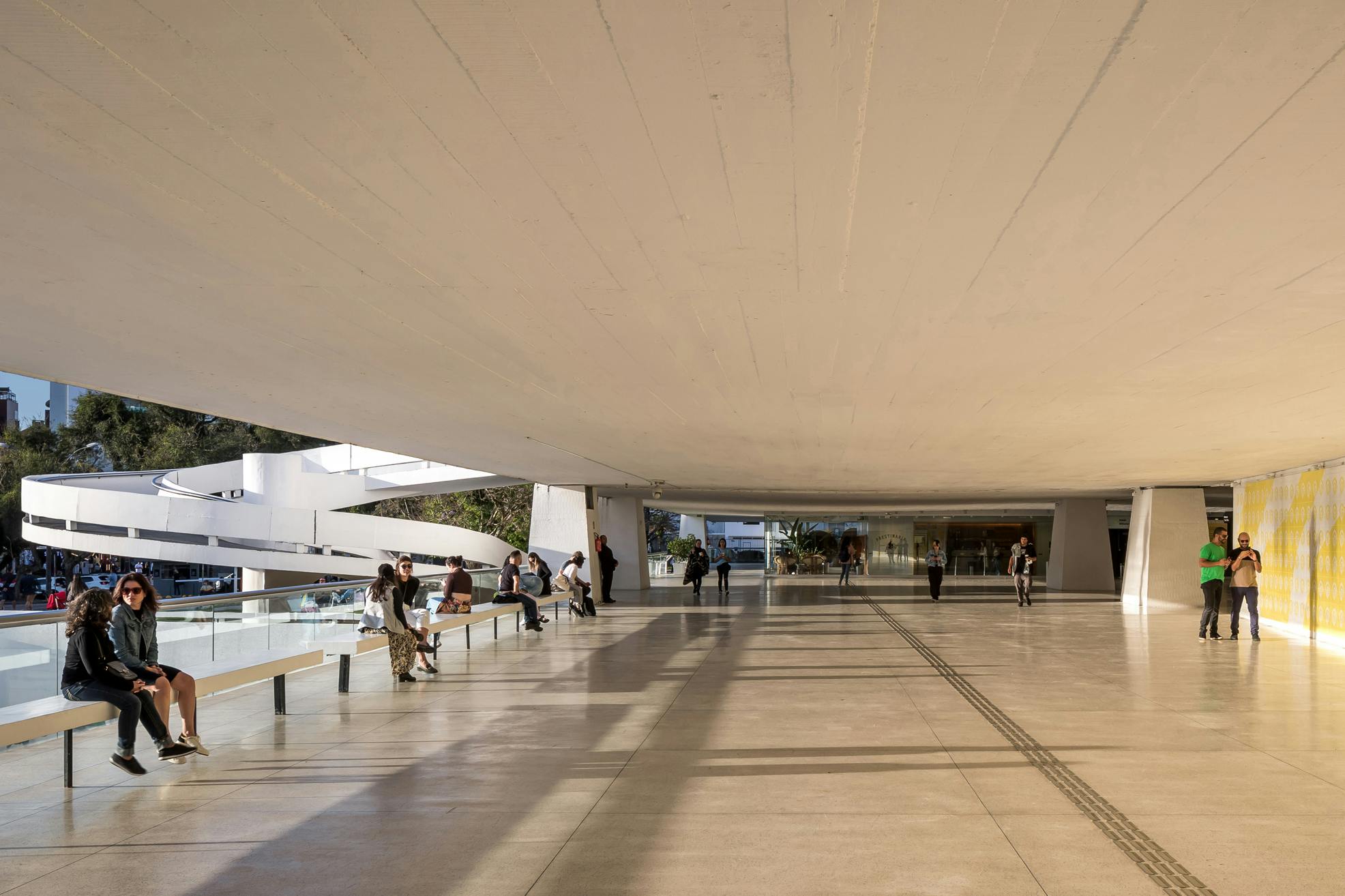
MON hosts new international exhibition at Olho
“Technological Dances”, by French artist Alice Anderson, is the next international exhibition held by the Oscar Niemeyer Museum (MON). The show will open on March 19th, at Olho and Espaços Araucária, and will bring together 75 works, including paintings, sculptures and installations, some of which are large-scale. The curator is Marc Pottier.
“Alice Anderson’s work invites us to reflect on the ways in which we relate to materiality and the transformations of our time,” says the Secretary of State for Culture, Luciana Casagrande Pereira. “It is an exhibition that amplifies the MON’s dialogue with international contemporary art and reinforces the Museum’s commitment to offering the public artistic experiences connected to discussions on the global scene.”
“In her performance art, the artist and her work become one. She creates through dance, producing unique paintings and sculptures based on intuitive movements. In this way, she prompts reflection on nature, technology, the body, and memory,” says Juliana Vosnika, CEO of MON.
"Her work creates visual and sensory experiences by mixing performance, everyday objects, and architectural structures in artistic pieces laden with poetic and symbolic meaning," she says.
Juliana comments that, in addition to the unprecedented nature of her work, the interaction with the architecture of the Olho exhibition space is enhanced. “Just as people have the power to adapt, Olho transforms itself, in a creative and unusual way, with each new exhibition. And this is probably one of the most creative that has ever been here,” says the director.
According to the curator, the exhibition is a record of her performative paintings. "Her instinctive and choreographed rituals aspire to a reappropriation of our relationship with a world governed by data management," says Marc Pottier.
“For over 20 years, Anderson has been engaging in dialogue with non-human beings,” explains the curator. “She observes, cares for, and dances with antique tools, modern machines, electronic circuits, architectural elements, or meteorites – reconnecting with their animated materiality, as if she wanted to repair our relationships with the more-than-human world.”
According to the artist, it was in this context of interaction between body and matter that the exhibition's title was born, juxtaposing the rigidity of technology with the fluidity of dance. "These two words really seem contradictory. However, both evoke movement. Technology is like a movement created by its constant evolution. It is designed to interact with the body and respond to it, whether by pressing a computer keyboard or imitating human gestures through robotics," says Alice Anderson.
The artist
Alice Anderson was born in France and lives in London. She is one of the few artists who creates paintings and sculptures during performances, applying liquid paint to objects to liberate them from their primary function. These entities, transformed into Technological Dances (paintings), become Awakened Objects (sculptures), recording communications beyond the visible world. They bear witness to another possible intelligence in the age of AI: that which inhabits matter.
Her work has been included in numerous institutional exhibitions, such as: MacVal Museum, Vitry-sur-Seine (2026); Centre Pompidou Malagà(2026), Stedelijk Museum, Schiedam, Netherlands (2023); Centre Pompidou, Paris, France (2022; 2020; 2017); Museum of Modern Art of Fontevraud, Fontevraud, France; Atelier Calder, Saché, France (2019); Royal Academy of Arts, London, United Kingdom (2017); Saatchi Gallery, London, United Kingdom (2016); Louis Vuitton Cultural Space Paris, France (2015); Wellcome Collection, London, United Kingdom (2014); 55th Venice Biennale (2013) and Whitechapel Gallery, London, United Kingdom (2012).